Slate masthead field with a concentric ring mark at its right edge

Circle of Insight

Notes on psychology and human behaviour

Attention Is Not One Thing

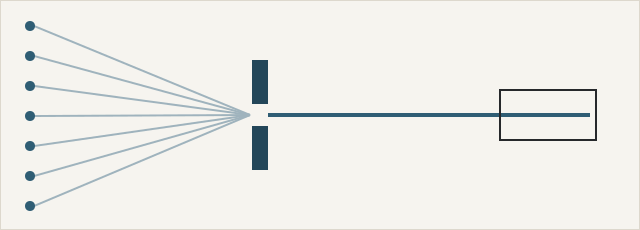
Schematic of many incoming signals narrowing through a gate into a single ongoing task
The gate picture of attention: many signals arrive, few survive into the task in hand.

Ordinary speech treats attention as a single quantity. People say they have run out of it, that a task demands more of it, that a child has too little. Experimental psychology has never been able to use the word that simply. When the topic was first studied under laboratory conditions, the question was narrow: given far more sensory information than a person can act on, what determines which part gets through?

The classic answer was a gate. Signals arrive in parallel, the argument ran, and something early in the chain selects one stream for fuller handling while the rest fade. Listening experiments, in which two different spoken messages are delivered at once and the listener is asked to repeat only one, gave the picture its early support. Listeners could follow one voice well and report almost nothing about the words in the other.

Where the simple gate broke down

The difficulty was that the unattended stream did not go entirely dark. Certain material, notably a listener's own name, tended to break through. That result forced a revision: if nothing about the ignored message were processed, nothing in it could be recognised as worth interrupting for. Later accounts moved the gate later in the chain, or replaced the gate with a graded attenuation, or dropped the single bottleneck altogether in favour of limited resources shared across tasks.

How Memory Rebuilds The Past

The oldest laboratory work on memory used nonsense syllables precisely to strip away meaning, and it produced the forgetting curve that still appears in every textbook: rapid loss at first, then a long slow tail. It was a real result, and it set the field's early habit of treating memory as a store whose contents decay.

The counter-tradition arrived with material that had meaning. When people were asked to recall an unfamiliar folk story after days or weeks, their versions did not simply lose detail. They changed shape. Unfamiliar elements were replaced by familiar ones, the sequence tidied itself into a more conventional narrative, and the tellers were confident throughout. Memory was not fading toward silence; it was drifting toward sense.

Sleep And Mood In The Research Record

Few relationships in psychology are as easy to reproduce as the one between disturbed sleep and low mood. It appears in questionnaires, in diary studies, in laboratory work and in clinical description, across very different populations. What that consistency does not settle is what causes what.

Sleep is not a uniform block of inactivity. Recordings taken through a night show repeating cycles that move between lighter stages, deeper slow-wave stages and the stage in which rapid eye movements and vivid dreaming occur. The mixture is not even across the night: deeper stages dominate the early cycles, while the later ones carry proportionally more of the rapid-eye-movement stage. Waking early therefore removes a different part of the night than going to bed late does.

The Long Argument About Habit

Habit is one of the oldest words in the discipline and one of the least stable. It arrived in nineteenth-century writing as a general principle of nervous plasticity, was narrowed by behaviourism into a learned association between a situation and a response, was largely set aside when the field turned to information processing, and returned late in the twentieth century in a more specific form.

Under the behaviourist account, a habit was a strengthened link between a stimulus and a response, built by repetition and reinforcement. The definition had the virtue of being measurable and the defect of leaving no room for what the actor expected the action to achieve. Since a great deal of behaviour plainly is governed by expected outcomes, the account looked less like a theory of action than a theory of one special case.

What Emotion Regulation Means In Psychology

In everyday use, regulating an emotion sounds like suppressing one. In the research literature it means something broader: any process that influences which emotion occurs, when it occurs, how intense it becomes and how it is expressed. On that definition, choosing not to walk down a particular street is regulation, and so is reframing an argument after the fact.

The organising idea in most of this work is that an emotional episode unfolds in stages. A situation arises or is sought out, some aspect of it draws notice, that aspect is appraised as meaning something, and a response follows across feeling, physiology and behaviour. Because the episode has stages, strategies can be sorted by where they intervene.

Bounded Rationality: A Short History

For a long stretch of the twentieth century the formal model of a decision-maker was a creature that knew its options, knew what each was worth, and picked the best. The model was never meant as a description of anybody. It was a normative standard. The trouble began when it started being used as though it were a description.

The first sustained alternative came from work in administrative decision-making, which pointed out that real decisions are made by agents with limited time, limited information and limited capacity to compute. Such an agent does not survey the option space. It searches it in some order and stops when it finds something good enough against a standard it carries into the search. The word coined for that stopping rule was satisficing, and the general position became bounded rationality.

Earlier notes in the archive