
Attention Is Not One Thing
14 January 2016·Attention and Memory
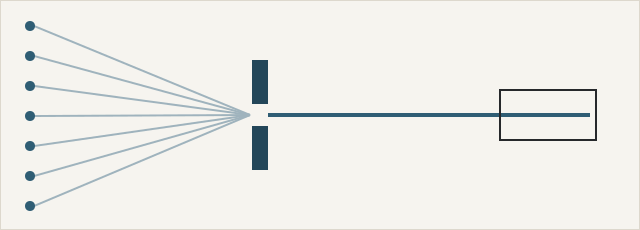
Ordinary speech treats attention as a single quantity. People say they have run out of it, that a task demands more of it, that a child has too little. Experimental psychology has never been able to use the word that simply. When the topic was first studied under laboratory conditions, the question was narrow: given far more sensory information than a person can act on, what determines which part gets through?
The classic answer was a gate. Signals arrive in parallel, the argument ran, and something early in the chain selects one stream for fuller handling while the rest fade. Listening experiments, in which two different spoken messages are delivered at once and the listener is asked to repeat only one, gave the picture its early support. Listeners could follow one voice well and report almost nothing about the words in the other.
Where the simple gate broke down
The difficulty was that the unattended stream did not go entirely dark. Certain material, notably a listener's own name, tended to break through. That result forced a revision: if nothing about the ignored message were processed, nothing in it could be recognised as worth interrupting for. Later accounts moved the gate later in the chain, or replaced the gate with a graded attenuation, or dropped the single bottleneck altogether in favour of limited resources shared across tasks.
What survived all the revisions is the observation that selection happens, that it is not free, and that its cost shows up as slower and less accurate performance elsewhere. That is the durable finding. The mechanism behind it is still argued about.
At least three different jobs
Contemporary writing usually separates the functions rather than arguing over one model. There is alerting, the general readiness to respond that rises and falls over a day. There is orienting, the movement of the spotlight toward a location or an object, which can be driven either by something in the world or by an intention. And there is control, the harder business of holding a goal in place while irrelevant but salient material competes for the same machinery.
These three come apart. A person may be highly alert and poorly controlled. Someone may orient rapidly to movement in the periphery while finding it hard to keep an intention active for ten minutes. Because they come apart, a single score labelled attention tells you much less than it appears to.
Why the distinction matters outside the laboratory
Most everyday complaints about attention are really complaints about control under interruption. The relevant literature is therefore about goal maintenance, interference and task switching rather than about sensory gating. Reading a study carefully means checking which of the several jobs its task actually measures, because the word in the title is the same in every case and the measurements are not.
Permalink: /notes/attention-is-not-one-thing